Welcome to the Mirror of Galadriel, a series in which we explore things that were, things that are, and things that yet may be.
Last time I teased that I would discuss a female hero who has never been reprinted. That hero is Molly Hake.
Things That Were: Molly
What, you’ve never heard of Molly? I can assure you she was a tournament-legal card.
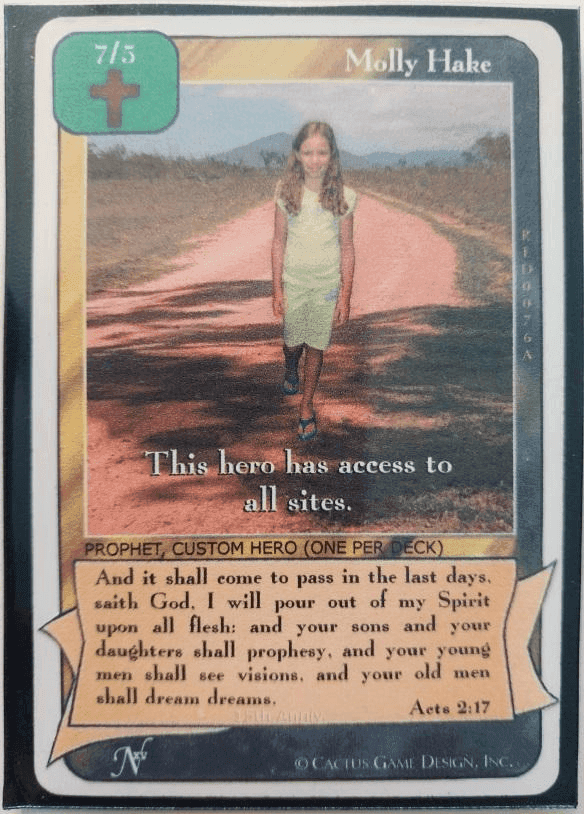
You see, at the 2010 Nationals, there was a special offer for players. You could spend $25 to make yourself into a custom hero. The hero would be tournament legal for the following season (2010-2011). Molly, one of my sisters, competed in Type A at that Nationals, so she had a custom made of herself. If you look at the right edge of the card, you can see the serial number 0076, meaning that at least 76 custom player cards exist. If you have one of these custom cards, I encourage you to share a picture of it. I think it would be cool for them to be compiled somewhere and saved as part of the Redemption historical record.
In designing your custom hero, the most important choice you had to make was your brigade. You could choose from 6 options: blue, green, red, gold, white, and purple. Clay did not exist at the time, and it was decided not to offer silver or teal because none of us are angels or temple priests. Depending on which brigade you chose, you would be given an appropriate corresponding identifier and N.T. verse. Molly’s favorite color is green, so that’s the brigade she chose, making her hero a prophet. My dad and I each chose white brigade because we wanted to be musicians. Yes, he copied my hero exactly. You can see by the serial numbers that I made mine first.
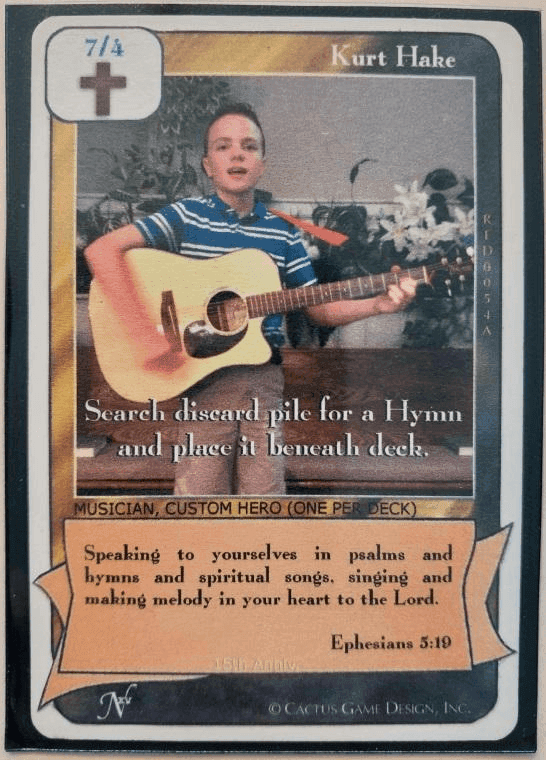
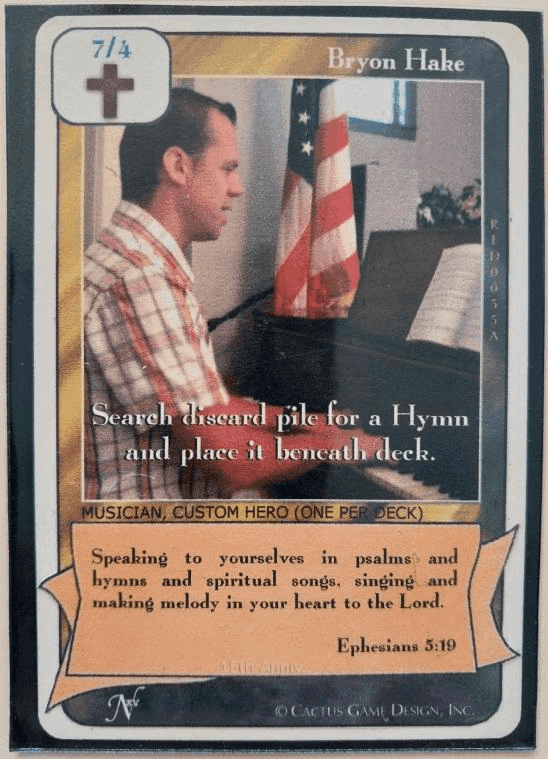
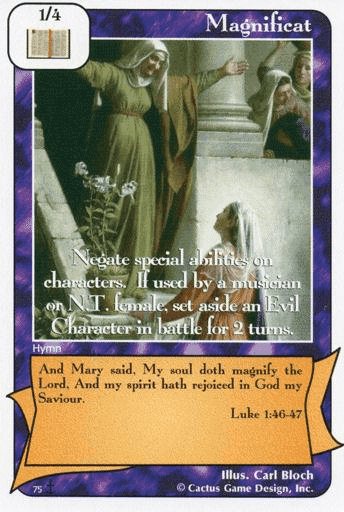
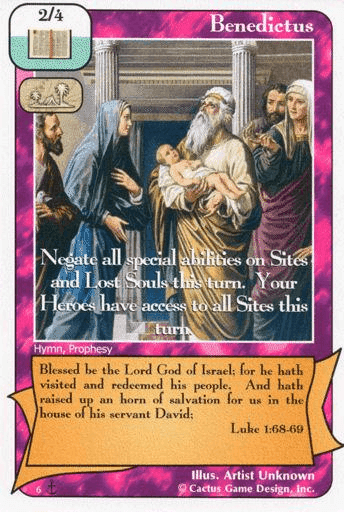
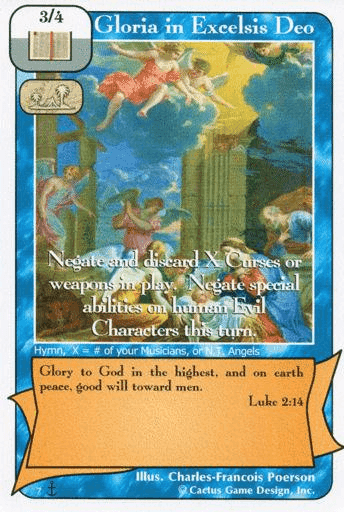
After choosing your brigade, you would choose your special ability. There were four ability options for each brigade. One option was site access, and another was banding (depending on the brigade, the band would be to a couple heroes like Soldier of God, Faithful Servant, Christian Soldier, Good Samaritan, etc.). The other two ability options were unique to the brigade. For example, my special ability of recurring hymns was only available to white. (Side note: this hymn ability was a special teaser for the Disciples set that released at the same Nationals, because there were no hymns in the game before that set. Players preordering their custom cards didn’t know what the hymns would be.)
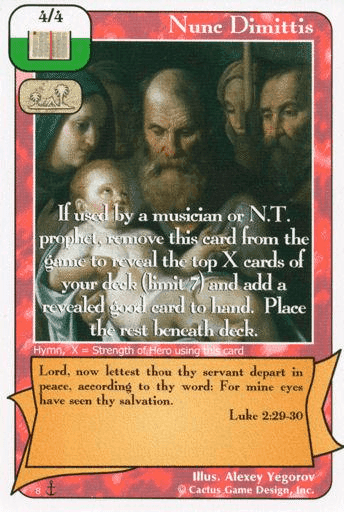
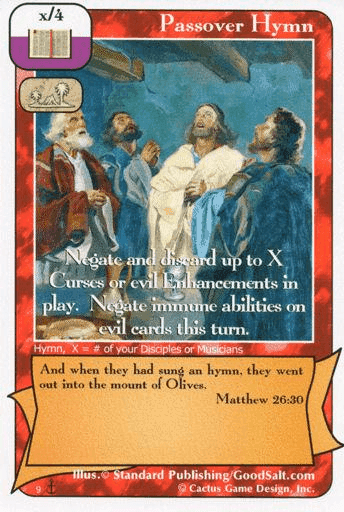
The last choice you had to make was to determine your stats. To prevent players from making their custom heroes too small (to get easy initiative) or too big (to make powerful bands), strength and toughness had to be in the range from 4/4 to 7/7. I chose my hero to be a 7/4, as that maximized strength (to overcome evil characters and rescue) and minimized toughness (to obtain initiative).
The custom hero event was a fun and special way to commemorate Redemption’s 15th anniversary. It would be cool if a similar event were run in the future.
Anyway, the reason that I specifically featured Molly’s custom hero is that her card was actually useful. I say this because the stats and special abilities available to custom heroes were intentionally weak, so that players without a custom would not be at a disadvantage. It would have been a problem if someone had made an overpowered combination for their hero, allowing only them to play the best deck all tournament season. But Molly, as well as any other girl or woman who made a custom card, had the advantage of her custom hero being female. In that era of Redemption, it was important to include female heroes in your deck, specifically to be able to rescue the female-only lost soul.

This was the time of lost souls like female-only and N.T.-only, as well as classic Burial and the old rules allowing players to rescue their own souls with Son of God and New Jerusalem.
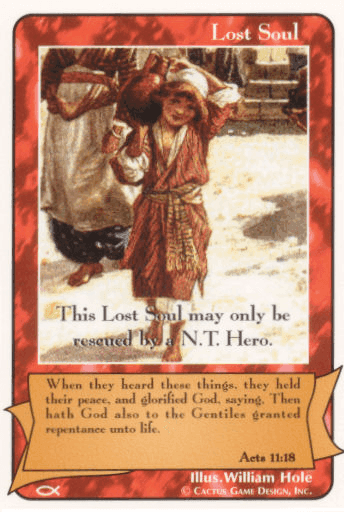
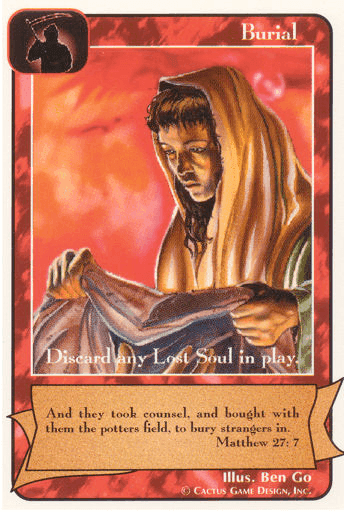
If you were not prepared for opponent’s restrictive lost souls, you could be locked out and face terrible soul drought.
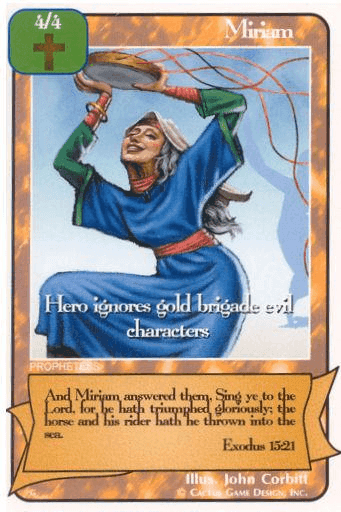
Some themes did not have a great female hero option (or a great N.T. hero option for that matter), so a custom female N.T. hero was a great opportunity. Take Molly’s custom prophet for example. At the time, the only female green prophet of much use was Miriam, and she was O.T. and only great against gold defenses. The most useful green prophets were all O.T. males.
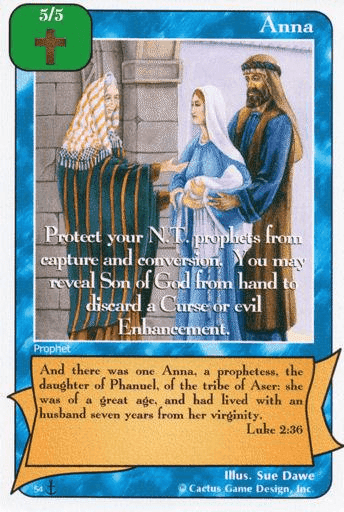
Anna did release at the 2010 Nationals, tying Molly for the title of first N.T. female green prophet, but it would be wise to have more than one N.T. female in your deck in case your first one was defeated. Plus, Molly’s hero had the advantage of site access. That means if the female-only or N.T.-only soul was held in a site, Molly would still be able to rescue it.
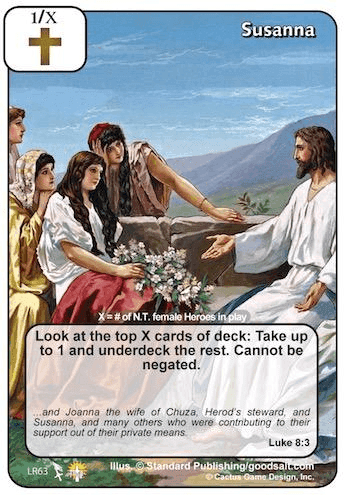
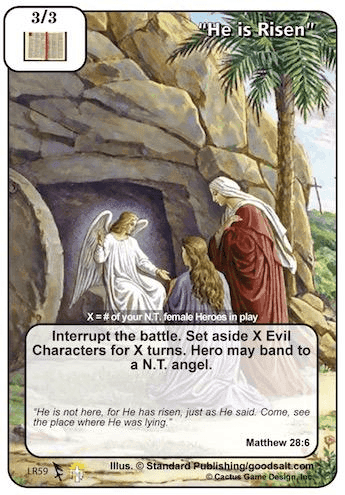
Custom N.T. female heroes were also a special opportunity because N.T. female was a theme in itself. Popular cards like Susanna and “He Is Risen” had their abilities scale with the number of your N.T. females. These two cards are less popular now, but they are both still available in rotation due to the legacy rares printed in Gospel of Christ.
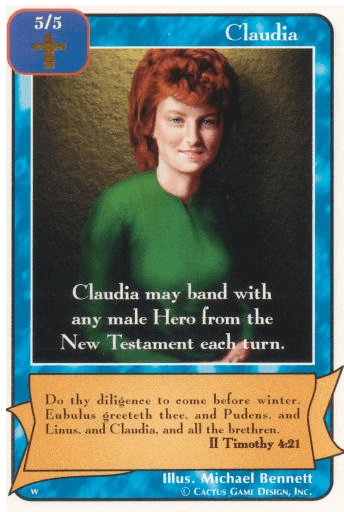
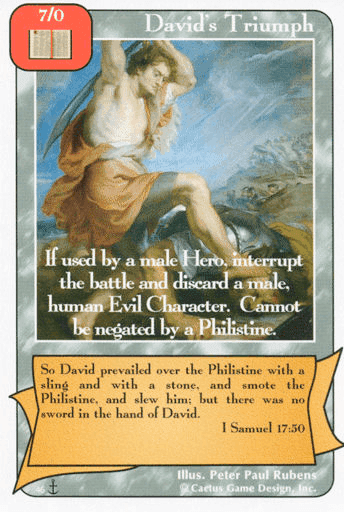
I should mention that despite how important female heroes were to decks at the time, they weren’t strictly better than males. Sometimes a special ability would make you prefer a male hero. For example, Claudia could only band to a male, and David’s Triumph could only be used by a male.
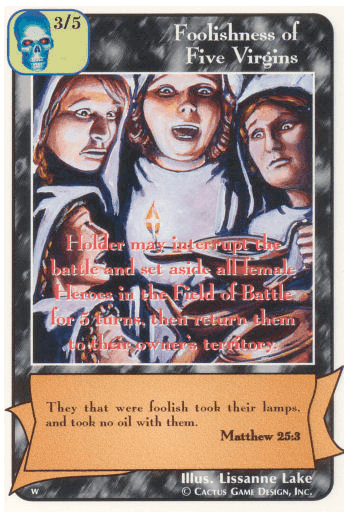
You might even have had to face evil cards that punished female heroes, such as how my friend Brandan Abbott played Foolishness of Five Virgins to tech against the popular Garden Tomb band. But overall, the scarcity of powerful female heroes made the custom hero opportunity an advantage for female players.
Ironically, I can’t remember whether Molly ever actually used her custom in an official tournament. I know she had a prophets deck with her custom card in it, but she did not play in tournaments very often. Mostly she just played at home with family.
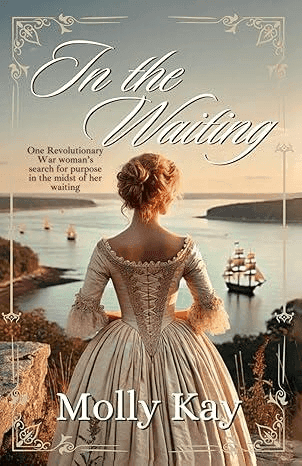
Before I move on to the next topic, I have a shameless plug. Molly recently published her first book, a historical fiction novel called In the Waiting. If it looks like something you or someone you know would be interested in, I encourage you to check it out. You can order it on Amazon here.
Things That Are: Modern Era of Lost Souls
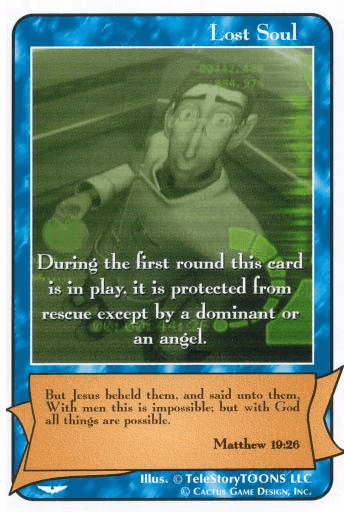
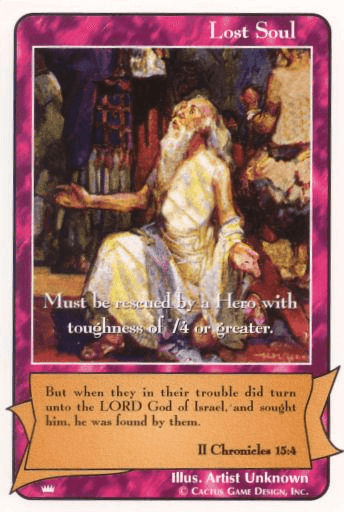
When I came back to the game last year, multiple players told me that the modern design for Lost Souls has shifted away from the restrictive abilities of the most popular scroll souls. However, I don’t think that is entirely accurate. It’s true that the female-only and N.T.-only souls are not legal in rotation, but restrictive souls still exist. There is now an O.T.-only soul, a 6/*-only soul, and a meek-only soul. There is even a prophet-only Lost Soul in the new set.
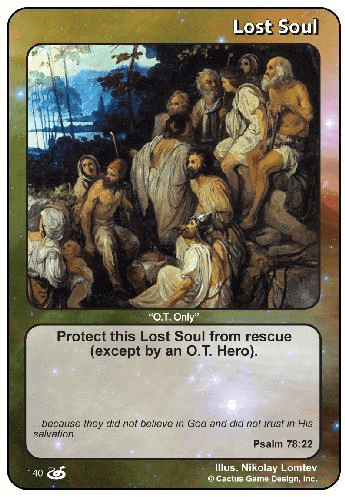
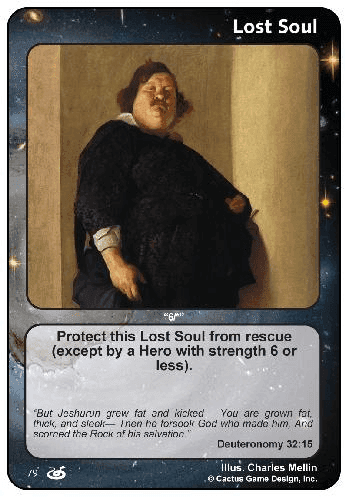
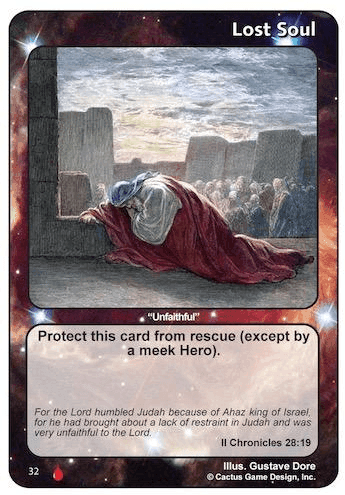
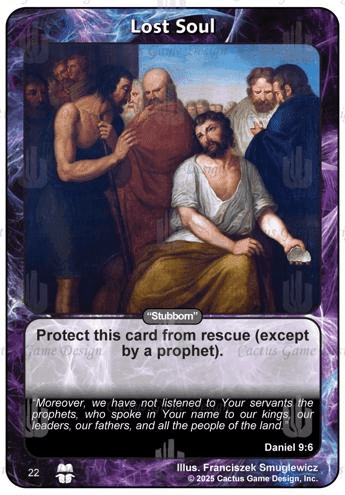
These souls represent a smaller fraction of all legal Lost Souls than similar ones did in the scroll era, but they are nevertheless part of the game, and there’s nothing stopping a player from including all 4 in a deck. So why does it feel like the design of Redemption has shifted away from restrictive souls? It’s because these souls have not been as effective as their scroll counterparts were. Due to a combination of factors, soul lock is a much smaller problem now. Here are 7 such factors:
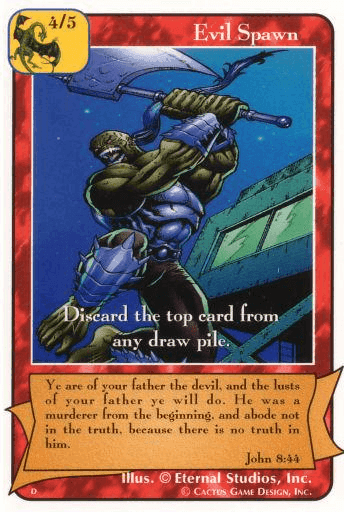
- Lost Souls cannot be discarded. This is now a game rule, but it used to be a given that opponent would use Burial to discard one of their Lost Souls. There was even a tricky strategy of using the original version of Evil Spawn to try to discard Lost Souls off the top of your own deck.
- Son of God (and New Jerusalem**) cannot be used to rescue Lost Souls in your own Land of Bondage.** This rule was changed many years ago, so it is easy to forget just how brutal Lost Soul drought used to be when opponents would rescue 2 of their own Lost Souls. If you lost your own Son of God to something like Confusion, and opponent eliminated 3 of their 7 souls via Burial, Son of God, and New Jerusalem, it was possible for you to be permanently locked out of rescuing, as only 4 Lost Souls would remain (and you obviously need 5 to win). Thankfully, this is now a non-issue.
- Site lock decks are not good enough to be played competitively. Sites have been largely phased out of the game, with none having been printed in several years. They are still legal to play in most categories, but competitive players only include them for their special abilities, not for site lock strategies. If a deck has any sites, it is rarely more than 1 or 2.
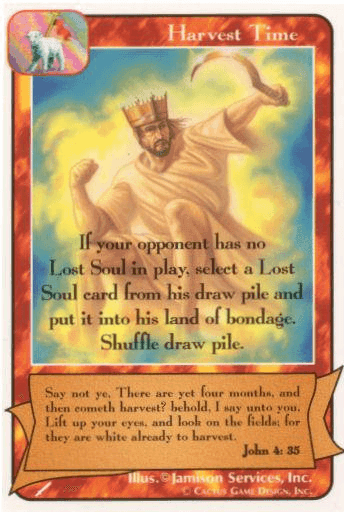
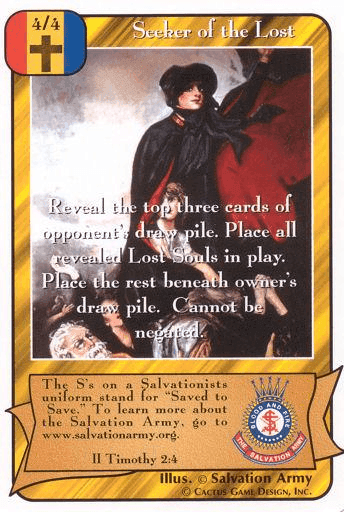
- There are many ways to search for Lost Souls. For years Harvest Time was the only way to search for a Lost Soul, and the classic versions only worked if opponent had no Lost Souls at all, so it didn’t even help if you were locked out due to sites, female-only, N.T.-only, etc. Eventually Seeker of the Lost was released, which was popular for a long time because her ability was unique. But now there are countless cards that play Lost Souls from decks. Every good brigade has options.
- There are several ways to negate Lost Souls. Many cards now negate Lost Souls, or even negate all neutral cards. Restrictive souls are obviously a non-issue while negated. If your opponent will soon play a card that negates your souls, you are much better off drawing a soul with an “if drawn” or “if put in play” ability that can activate in time before your souls are eventually negated.
- You can generate Lost Soul tokens. Even if opponent has a Lost Soul that is impossible for you to rescue, you can generate tokens, sometimes causing there to be many more available than you would ever need. The “Lost Souls” Lost Soul is a particularly effective option, which is good because as a Roots card, it is cheap and easily accessible to new players.
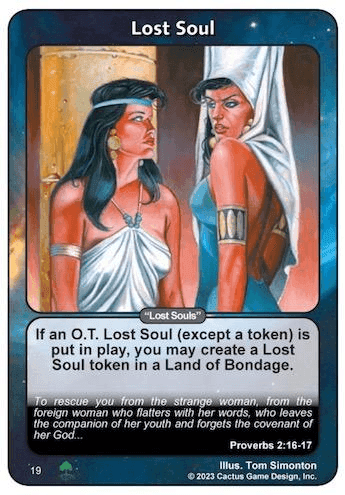
- Restrictive Lost Souls are rarely included in decks because there are so many other options. It is difficult to justify putting restrictive Lost Souls in your deck when you could instead run souls that increase the speed of your deck, help your offense, negate opponent’s cards, generate Lost Soul tokens, etc.
For all of these reasons, soul lock is a much smaller part of modern Redemption, and I think the game is healthier for it. Few things in Redemption are as frustrating as soul drought, and being locked out of the souls that are available is not much better. Now there are so many ways to avoid soul lock that even dedicated “soul hide” defenses can struggle to keep souls hidden.
Things That Yet May Be: Jezebel
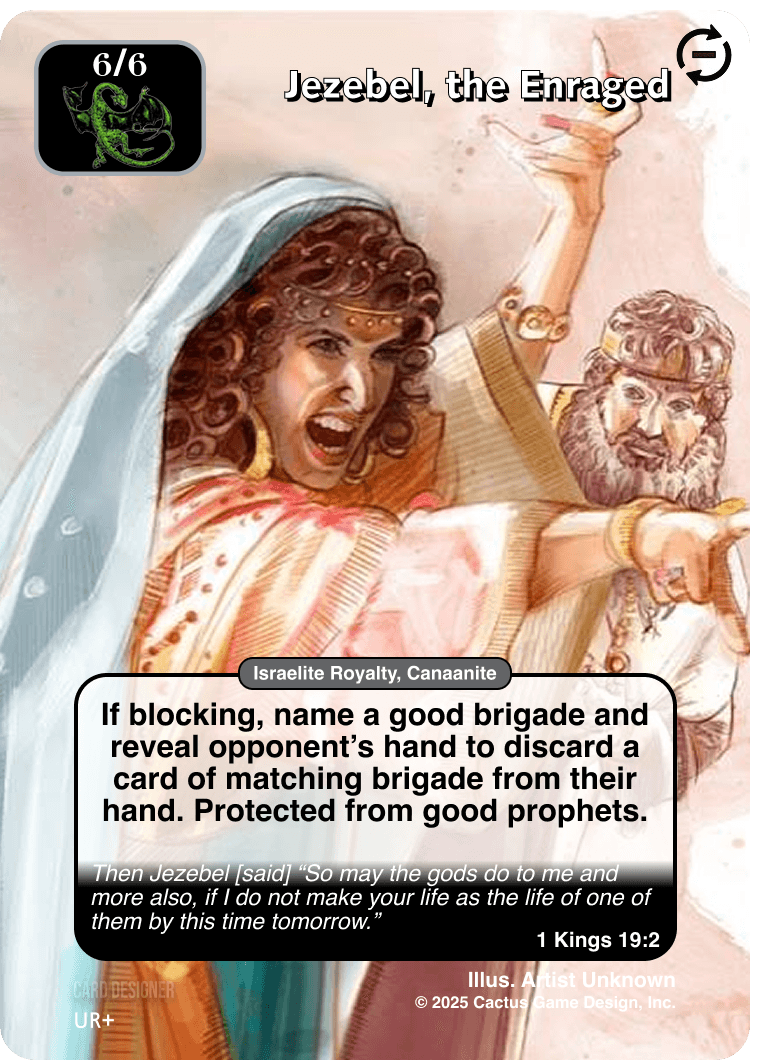
Last week, I asked readers to design a new Jezebel. BaboonyTim rose to the challenge with a creative design that uses a brand new mechanic: Transform. Jezebel begins as Jezebel, Wicked Queen and can then transform into Jezebel, the Enraged if angered. Don’t make her angry; you wouldn’t like her when she’s angry.
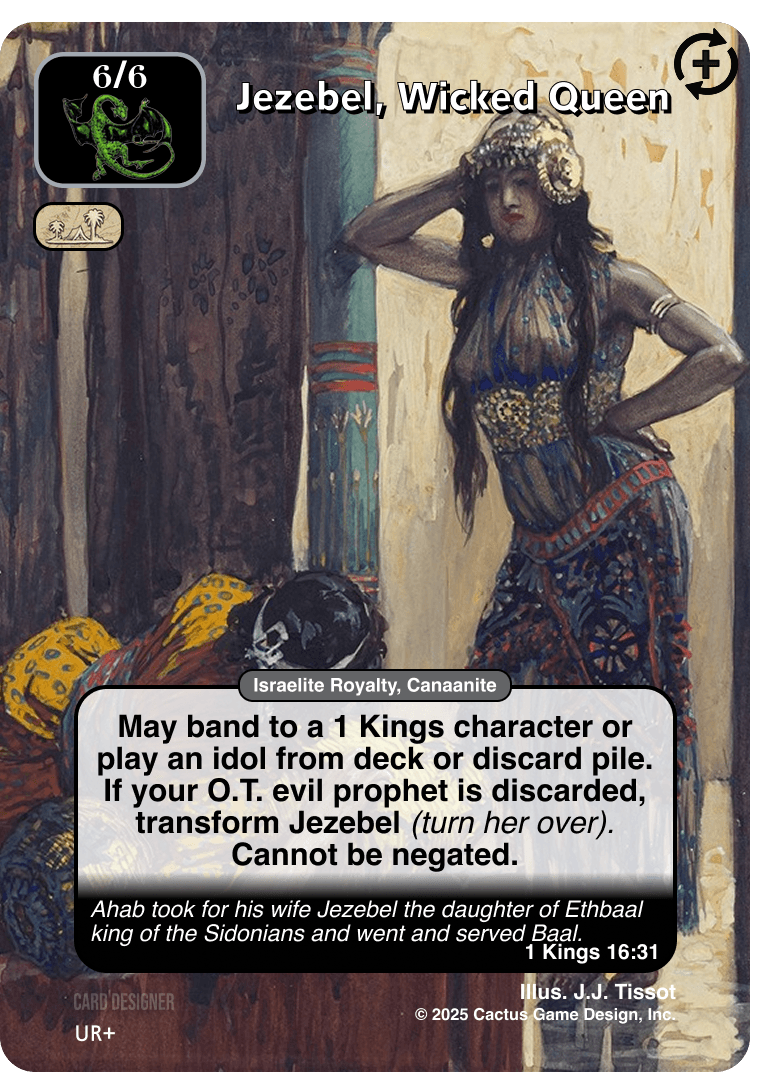
Tim’s design brilliantly represents the change in Jezebel after her story’s turning point on Mount Carmel. At first she can band to a 1 Kings character, including thematic options like King Ahab or Prophets of Baal, as well as many other interesting choices like Foreign Wives, Queen Tahpenes, and Rehoboam the Divider. Or, instead of banding, she can search for an idol and immediately activate it (representing how she brought her idols to Israel and influenced the whole nation to idolatry). Activating Abomination of Desolation can discard a hero from battle, and the especially thematic Asherah Pole and Idols of Canaan can each provide surprise protection for her in specific circumstances.
But if one of your O.T. evil prophets is discarded (like the many killed on Mount Carmel), Jezebel becomes enraged. Her new ability is to name a good brigade, and then discard any card of that brigade from opponent’s hand. On top of that intimidating effect, she is protected from good prophets. This is thematic, because it is the time at which Elijah fled in fear from her and in a sense “gave up,” the beginning of the end of his ministry. It was not a prophet like Elijah or Elisha who finally stopped her, but rather the new king, Jehu.
I also like that this Jezebel is an ultra-rare. She’s definitely an iconic enough character to deserve it. Thanks for submitting this awesome design, Tim!
I also decided to make a Jezebel, though mine is not nearly as cool as his. I also got carried away designing a few support cards for her.
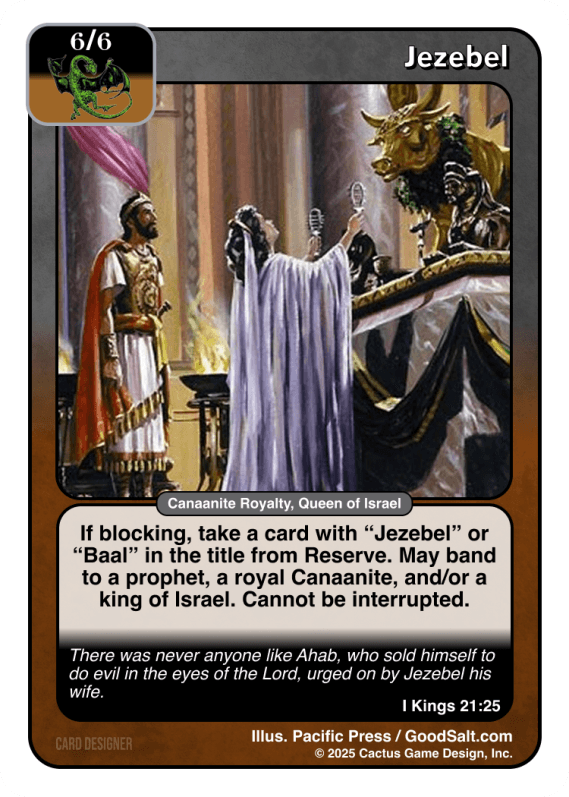
This is my concept for Jezebel. Currently in rotation there are 4 different enhancements that she could take from reserve. Most notable is Wickedness of Jezebel, a battle winner that is CBN if used by her. She can instead take either of the evil characters with “Baal” in the title, both of which are prophets she could then band into battle (though neither prophet is very strong). I wanted Jezebel to be usable in a deck of evil prophets, Canaanites, or royalty of Israel. Thus, her band ability works with any of these, or better yet all three at once. It could be really fun to figure out the best combinations of prophets, Canaanites, and royals to band together. The banding part of her ability would even work if she is converted. For instance, she could band to Elijah, Hiram, and David.
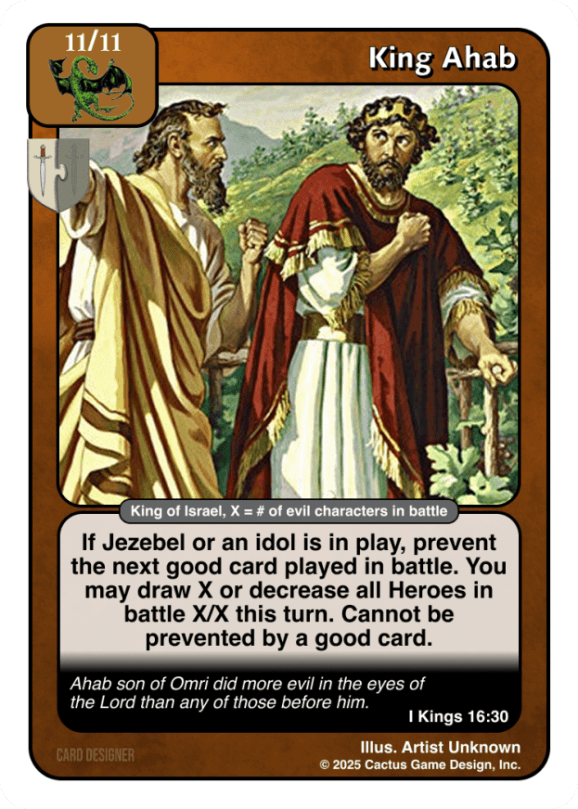
I thought it appropriate to keep Ahab’s stats at 11/11 because he reigned 22 years. The evil kings of Israel do not have much of a presence in rotation, nor a defining strategy among their legal cards, so choosing a special ability was rather open-ended. I decided to use a decrease effect, as decreasing heroes via Gates of Samaria was a big part of classic kings of Israel decks; however, I made the decrease temporary so that it wouldn’t be difficult to track. As is thematically appropriate, Ahab is much more of a threat with Jezebel. Not only does she enable his prevent effect, but her banding also significantly increases the effectiveness of his decrease ability. If you band enough evil characters into battle with Jezebel and Ahab, you could potentially decrease all the heroes enough to discard them. At the very least, decreasing them a bit should provide some successful blocks when preventing the next good card.
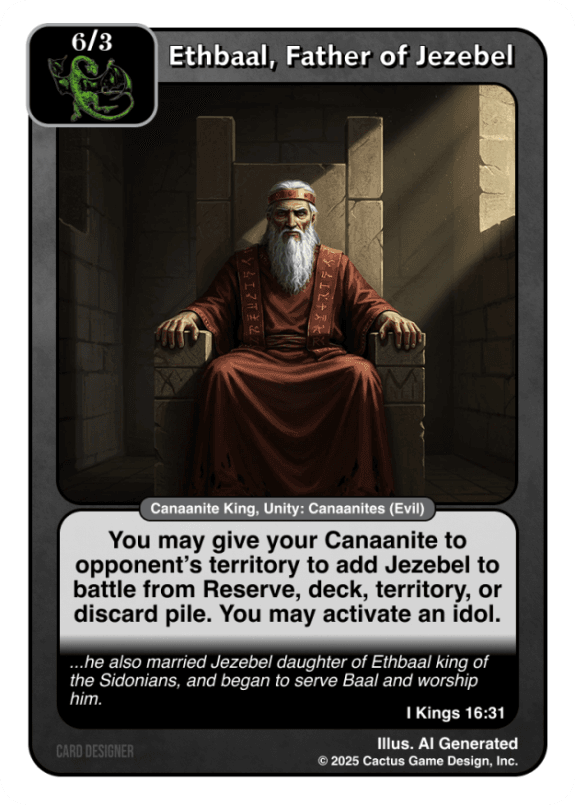
I’m not sure whether the name Ethbaal counts as having “Baal” in the title, so I added the subtitle Father of Jezebel to give him “Jezebel” in the title. I created Ethbaal as a way to more effectively slot Jezebel into a pure Canaanite defense, but he could also be included as a consistency piece for a hybrid black/brown defense. He gives a Canaanite (himself if necessary) to opponent to add Jezebel to battle from almost any zone, even from discard pile. This makes Jezebel much harder to permanently remove. This would also cause the thematic win of making Defenestrated! a better option against Jezebel, as banishing her would be one of the rare ways to permanently eliminate her. Whether or not you add Jezebel to battle, Ethbaal can activate an idol. This can be used to try to win the battle via something like the idols I mentioned for Tim’s design, or it can be used to activate the last custom card.
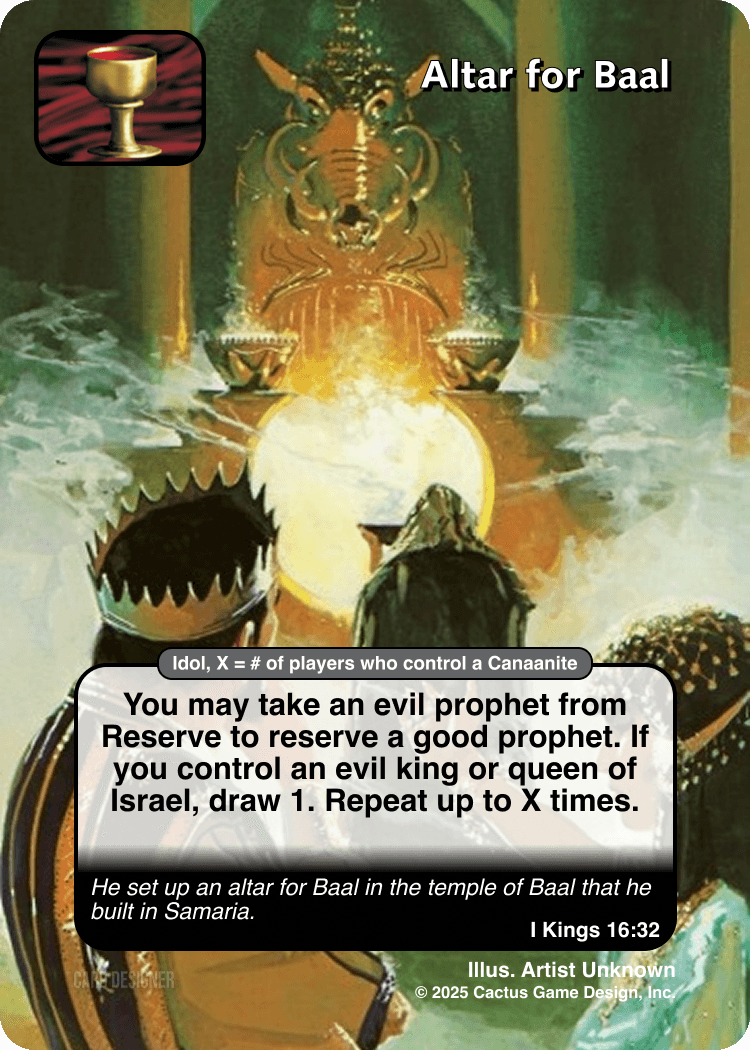
Editor's Note: This card is sweet lookin...
I created this artifact so that there would be an idol with “Baal” in the title, as well as so that there would be another payoff for mixing evil prophets, Canaanites, and kings of Israel. I like the symmetry of taking an evil prophet from reserve to send a good prophet to reserve. This is thematic because the reign of Ahab and Jezebel caused the surviving prophets of God to go into hiding in Obadiah’s caves, while many prophets of Baal began practicing wickedness in the open. The draw ability then provides a bit of speed. Because Baal was a false god of the Canaanites, his worship was a prime example of the evil influence of the Canaanites on Israel. Scaling the ability based on the number of territories the Canaanites have infiltrated seems thematically appropriate. Jezebel herself is both a Canaanite and an evil queen of Israel, so she enables both the draw ability and the repeat ability.
Card Creation Prompt
If you would like to create a card for the next article, this week’s challenge is to design a Lost Soul. It can be whatever you want: inspired by a scroll card or something entirely new. If you do make one, please submit it to me (Ear-A-Corn on Discord) by the end of Friday, 9/5.
I hope you enjoyed this article. Next time I will share an old meme deck that found unintended success at Nationals.
To buy singles, sealed product, and other gaming supplies mentioned, please visit our sponsors!